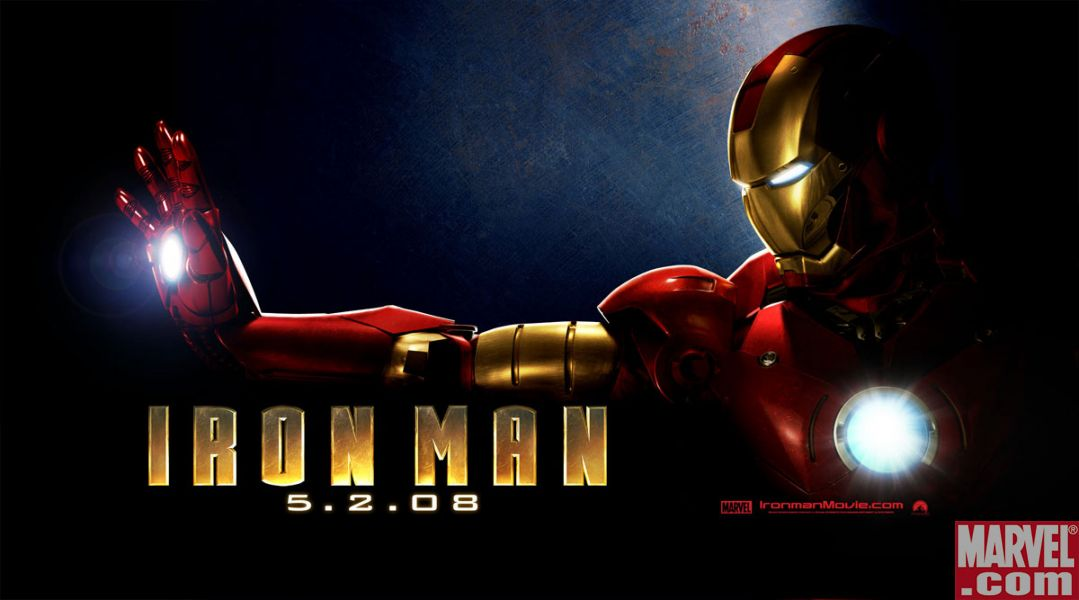
Release date: May 2, 2008
Director: Jon Favreau
Cinematography: Matthew Libatique
Based On: Iron Man, by Stan Lee
Production Company: Marvel Studios
Cinematic Universe: MCU (#1)
Logline: An immature, obscenely wealthy arms merchant is fatally injured and captured by terrorists armed with weapons of his own manufacture; in order to escape and undo the harm he his brought to the world, he must become a weapon himself.

Bone Ranking: Essential
Cinematically or Genre Significant; Must-See
Iron Man is the Quintessential Superhero - and Supervillain - of the Modern Era
Iron Man was the stone upon which the MCU built its church, sometimes to its detriment. Films like Doctor Strange and Ant-Man crib off its formula to such an extent you would think their existence would make this film less special. And yet, it is those newer films that suffer in comparison to what this film pulls off. Iron Man is political; Iron Man is fun; Iron Man is more than a ‘superhero’ film - it is the superhero film that best represents 2008, more so than even The Dark Knight. Robert Downey Jr. is Tony Stark, who is Iron Man: his charisma and natural personality becomes the character, a formula that Marvel wouldn’t realize it needed to implement for all its heroes until Phase 3. In terms of what would become the Marvel formula, this film contributes its two biggest problems: an underdeveloped and inconsequential villain and third-act smashing that feels less than the film preceding it. It also contributes the MCU’s biggest strengths - an emphasis on exploring character, inner conflict, redemption, the use of humour to grease a story along, political commentary, and ‘heart’. In this case, the journey to find one in the body of a man who tosses women aside like wrapping paper once he’s had his fun with them; a man who proudly accepts the moniker of ‘Merchant of Death’; a man of great brilliance, content to use that brilliance not to help mankind, but to enable its most destructive and violent impulses. A man who is a capitalist first, a playboy second, and an example of what the worst of modern excess can produce. Steve Rogers is what America wishes it was; Tony Stark is what America really is. The rivalry between the two characters is understandable. In order to find his heart, Tony first had to have his physical one torn apart by shrapnel; in order to make something of his life, he first had to nearly lose it. Before he returned to his mountaintop, he had to first grub about in a cave with a box of scraps. Tony Stark is the 1% made to reckon with the world he has wrought...and that continues to be relevant.
I was 14 years old when Iron Man came to the little cinema in Okotoks, my home town. Even at that tender age, I was already several years into the habit of reading newspapers for an hour after getting home from school every day. It did not make for a very optimistic worldview. Despite my mother being somewhat American, you would’ve been hard pressed to find a child with a lower opinion of the country than me. George Bush regularly embarrassed himself, the war with Iraq waged on, school shootings were rampant, and all of it, to little me, seemed like a mess that would be easily cleared up if there was a little less greed and fear in the world. Iron Man could’ve had it easy - it could’ve been a rah-rah ‘Murika F-Yeah! Kind of film. But instead, it very clearly and very pointedly turned the finger of blame back on America itself. This intrigued me, as it seemed at odds with what the superhero genre tended to do - which is glorify the ‘American Way’. Tony Stark’s films, instead, worked to tear down the might-is-right mentality that had so thoroughly caught up America at that time (at least to my preadolescent eyes).
SPOILERS AHEAD
The villain of the first Iron Man film is not the Ten Rings, nor their scarred leader. It isn’t even really Obadiah Stane, Stark’s mentor and foster-father who is the first of the ‘dark-mirror’ villains the MCU is so fond of. No, the villain is Tony Stark himself, and the Military Industrial Complex of the United States. The weapons used to attack Tony at the start of the film are of his design. Yen Sin, the man who saves Tony’s life with a car battery and kindness, had his family killed by men armed with Tony’s weapons. He himself is later killed buying time for Tony to escape. And when Obadiah Stane later turns on Stark, he causes mayhem with a replica based on Tony’s Iron Man suit. Tony may not have had his finger on the trigger, but for years he was content to make the trigger and profit from its pulling. Also villainous is the system that repeatedly turns to him for bigger and better weaponry, turning the art of war into a rock concert, and making Tony Stark a rock star. This thread would be continued into the other Iron Man films, as the government repeatedly seeks Tony’s designs for use in foreign wars, while Tony himself wants to focus on energy creation and other things that improve lives instead of end them. True, there are some uncomfortable scenes of Tony, a billionaire in advanced tech, taking down brown people in the Middle East with tank missiles and getting to feel like a gawdang hero; and yet even that scene ends with him getting shot out of the sky by the American military itself, foreign interventionism clashing with foreign interventionism.
So while erst-while bad guy Obadiah Stane lacks the emotional connection he should have with his foster son, and is largely forgettable because of it, Tony Stark proves to be the combination of hero and villain that would last through a ten-year franchise. He is used as the full-blown antagonistic force in the Avengers 2.5 film, Civil War, and causes the creation of supervillains such as Spiderman: Homecoming’s the Vulture, Iron Man II’s Sam Rockwell and Whiplash, Iron Man 3’s Aldrich Killian and Maya, and finally Age of Ultron’s Ultron, Quicksilver and Scarlet Witch. His giant arc reactor is used to open the alien portal in The Avengers, his Iron Legion becomes a symbol for oppressive government, his creations constantly teetering between mad science and a light for all mankind to share. When I was little, it bothered me that superheroes were the ones who came into their powers by accident - a slip in toxic waste, playing with radioactive bugs, an unlucky affinity with meteor strikes, by birth - wrong-place-wrong-time kinda stuff. Meanwhile, the bad guys would be those who worked for their powers - geniuses who built incredible machines, or else CEOs who ran massive companies after working their way up from nothing, or creators of scientific breakthroughs brave enough to test their formulas on themselves. It implies that heroes should be chosen by fate and not self-made. Tony Stark would be a supervillain in most stories. And he still kinda is - which makes for the most compelling modern-day take on the superhero we’ve seen in cinema yet.
Tony Stark is more essential to the understanding of this genre in the modern age than Batman, Superman or Wonder Woman. In time, he will be replaced - likely with Black Panther - as the most relevant and important figure in the MCU. But his defining of an age of American cinema won’t soon be forgotten.

Stand-out scene: Tony, having had his arc reactor removed by Stane, must claw his way into the heart of his workshop to recover the one built in the cave, lovingly saved by Pepper. The strain and suffering it takes for his every movement is palpable, and in the end - he can’t quite make it. It feels like the movie in miniature, and with the snark turned off for a few minutes, we are privy to Tony in his most vulnerable state.


No comments:
Post a Comment